What you need to know about humans is that they are dicks. And if you give them any power their dickness prevails over everything else.
That beautifully succinct phrase comes from a review
on Good Reads and is an understandable frame of mind to find yourself in after reading this book. Reading it ten years after publication, it’s almost surreal how little has changed in the intervening period, how the wheels of progress continue to grind on the gears of conservatism. In Freedom Next Time John Pilger surveys the state of peoples suffering under the weight of ignorance, ill-will, apathy and condescension in various theatres of the world, turning the spotlight in turn on Palestine, India, Afghanistan, South Africa and the Chagos Islands.
Some years ago (last decade!
) I decided to do a brief round-up of some recent reads. Sadly I don’t find make the time to gather my thoughts and sum up my opinions, so in no particular order, I thought I’d write a few words on some of the books that have graced my bedside table over the past few weeks.
Statistics! They’re everywhere… and I seem to have collected a lot of my own. This post isn’t of any interest to anyone, but I just thought I’d write up what media I’ve been consuming over the past twelve months.
Reading this post
recently, I found myself asking why ebooks haven’t really taken off as a medium. Certainly more recent efforts, such as Amazon’s Kindle, have helped to reignite the market after a rather dubious development period over the past decade or so, but if one compares the ubiquity of mobile phones or digital audio players, e-books are entirely missing from the landscape. ((According to The Guardian
in April 2008, ebooks accounted for less than 1% of the total publishing market, albeit this share has no doubt increased since.))
In purely utilitarian terms, should the technology ever be fully and appropriately used, ebooks have a lot to offer over their paper counterparts. There are far fewer requirements and resources needed for production, and distribution is much easier. Whilst a device on which to read ebooks might outweigh a single volume, additional books add nothing, and in terms of transporting books en mass, ebooks are clearly in favour. The ability to flick through a paper volume might be lost in the electronic form, but this is clearly compensated for by vastly improved tools for search and cross-referencing. Likewise combining other forms of media such as video and audio is a perfectly reasonable conception with ebooks, that the paper variety can’t really compete with on any level. They’re also more easily manipulable, in terms of being able to zoom, highlight or simple leave your own annotations about the place. All of which is to say nothing of the potential advantages for newspapers and other periodicals.
It’s fairly rare for me to bother reviewing anything I read on here, however since I had some spare minutes and some actual opinions on some of the books I read this last month, there seemed to be enough to say to make up at least a short post. In fact it turned out to be a bit on the long side, so scroll down the relevant review if you’re really interested—being Stephen Fry’s strange debut The Liar
, J.M. Coetzee’s rather aggravating Slow Man
, Isabel Allende’s book for children City of Beasts
, Zadie Smith’s impressive opener White Teeth
and Murray Walker’s charming little autobiography Unless I’m Very Much Mistaken
.
This is one the larger circulars out there, of a fairly arbitrary list of books to read. The source is a title of the same name that appeared in print, edited by Peter Boxall. It’s not a particularly bad selection, and with any such list it would be impossible to please everybody, but I think it is fair to say that the more recent decades were rather over-represented (in particular 70 books from the 2000s, despite the book only being published in 2006). However, the list does make a good starting point, and it’s nice to see Miss Rowling’s works were conspicuous only by their absence — just such a shame that the price to pay was that of excluding all children’s literature.
As for getting through the list, I doubt very much if I’ll even read 1001 books before I die, let alone fiction books, or the particular ones from this list. However, I have ticked off a few titles already, and no doubt as many of them coincide with titles on my reading list I’ll be able to whittle the list down a little further. Titles I’ve read to date are in bold.
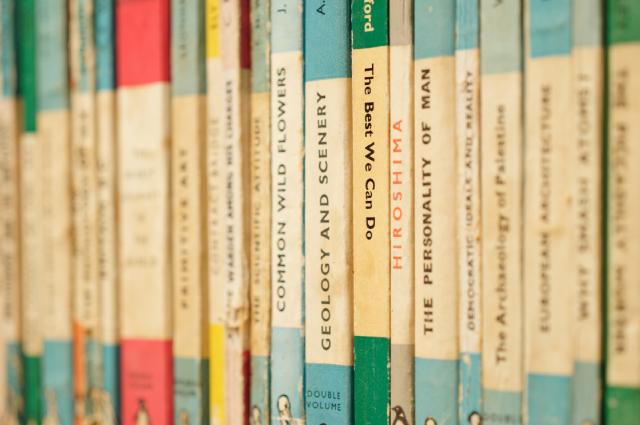
As an avid reader, it often occurs to me just how second-hand book retailers manage to turn a profit. Even assuming the raw stock can be acquired at very little cost, the vast majority of books can go unsold almost indefinitely, all the while occupying shelf or storage space that costs money to maintain. I read somewhere that on average a second-hand bookseller can expect a third of his stock to be sold within six months, another third to be sold on an indefinite timescale, and the final third to simply go unsold. Obviously this has a knockon effect where turnover is slow. On a recent trip to Wigtown
, Scotland’s National Book Town, I came across plenty of bookstores that clearly have to elevate prices to remain profitable. No doubt in their case, the annual book festival and holiday season are a major source of revenue that would otherwise cause most to close their doors in an otherwise small and overcrowded market ecosystem.
Courtesy of Caro
, here’s my contributory few lines from The Lives of the Great Composers by Harold C. Schonberg, page 123, three sentences from the fifth one on:
And, indeed, the coda of the first movement, with its slippery, chromatic bass and the awesome moans above it, remains a paralyzing experience. That is the way the world ends. It is absolute music, but it clearly represents struggle, and it is hard to hear so monumentally anguished a cry without reading something into it. The trouble is that face with such music, all of us tend to become sentimentalists, reading into it the wrong message.