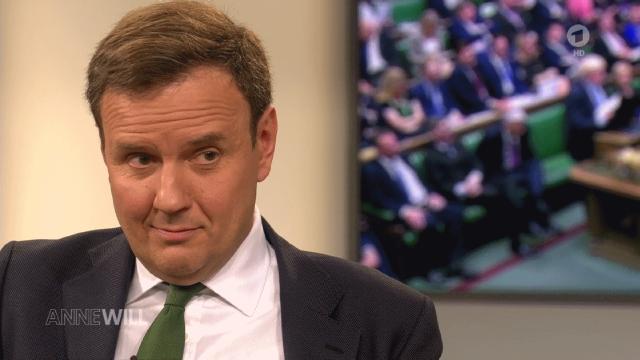
You almost have to feel sorry for Greg Hands, sitting as a guest on Anne Will’s show, trying to defend Tory policy. Invited to a five-to-one Brexit bashing, it’s a debate of the ilk where the quacks aren’t invited in the name of ‘balance’. From the off, and as if to distance himself from the madness he’s supporting, Hands immediately claims to have been anti-Brexit, to have been anti-Boris during the leadership change. But not one to let principles get in the way, he’s supporting both of them because ‘democracy’. What follows is a virtuoso display of logical acrobatics skills as he attempts to defend his position: the shittiness of Britain’s democracy (being old is apparently a compliment?); that the referendum somehow showed clarity of purpose; that Boris threatening to ignore the law to push through a no-deal Brexit is democracy in action; that proroguing parliament is standard procedure and clearly shouldn’t be reconsidered at such a crucial juncture; that an election could show what the people want, but a second referendum would be undemocratic. If he weren’t sitting there looking like a naughty schoolboy called to the headmaster’s office, his mind-bending mental tricks might have earned some applause.
As Thomas Hobbes once fathered the phrase, life before the central state was solitary, poor, nasty, brutish, and short. In Jimmy Aldaoud’s eyes, life with the United States wasn’t much better. Aldaoud was victim to the kind of cretinous bureaucracy touched by a sprinkling of laughable xenophobia. Not that there’s anything funny about the result. A man died as a direct consequence of the kind of senseless and callous rule-making that surely the gobbiest semi-democracy in the world ought to be a little ashamed of.
Surveying today’s political landscape, it’s easy to suppose we’re approaching a precipice. Passionate intransigence divides societies into blocks which, even where decidedly secular, are rallied around with religious fetishism. It seems that ideological boundaries are increasingly hardening, poisoning the political dialogue, preventing constructive discourse and contributing to almost maddening levels of senseless blustering.
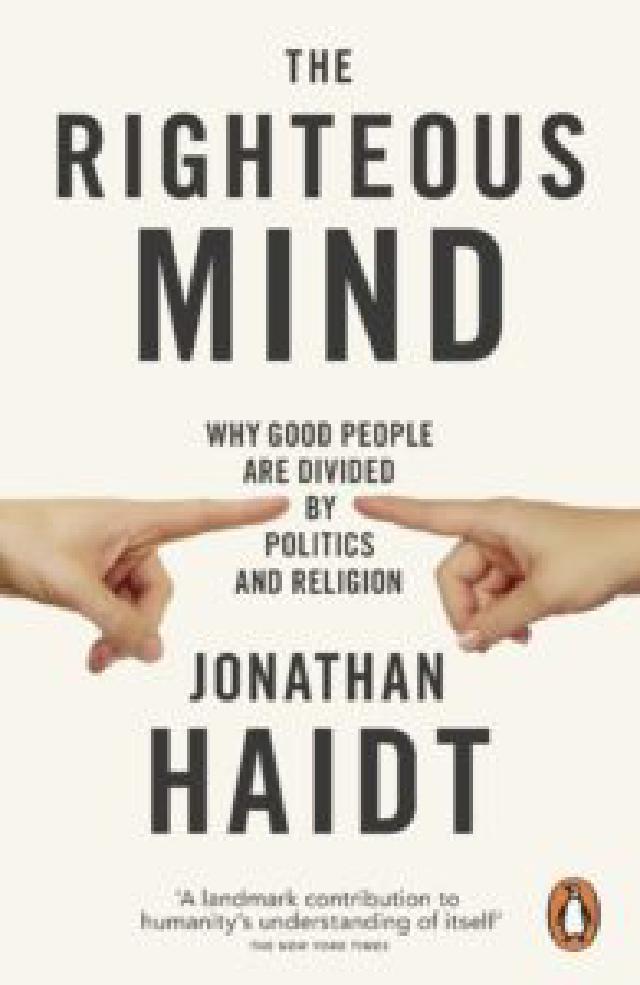
In The Righteous Mind, social psychologist Jonathan Haidt investigates the concept of morality and shows how differing political groups can reach such disparate conclusions from the same starting point. Gradually building up his argument, Haidt succinctly retreads a lot of territory covered elsewhere in more detail, but which is vital to understanding his standpoint.
Back in the UK for a while watching the Brexit bullshit slowly roll from one stagnant puddle to the next, occasionally spattered by the shrill wailing tweetarrhia from Trump’s cot, it’s sometimes tempting to imagine we are really all lying inert, plugged into machines while hackers play pong on the Matrix. Is there an infectious disease going around causing collective cerebral atrophy? Maybe a race of bodysnatchers seeding the populace with cretins wondering how long it will take us to twig? Or are we just watching the unfolding of H. L. Mencken’s prophecy
and the glorious consummation of democracy and technology?
What you need to know about humans is that they are dicks. And if you give them any power their dickness prevails over everything else.
That beautifully succinct phrase comes from a review
on Good Reads and is an understandable frame of mind to find yourself in after reading this book. Reading it ten years after publication, it’s almost surreal how little has changed in the intervening period, how the wheels of progress continue to grind on the gears of conservatism. In Freedom Next Time John Pilger surveys the state of peoples suffering under the weight of ignorance, ill-will, apathy and condescension in various theatres of the world, turning the spotlight in turn on Palestine, India, Afghanistan, South Africa and the Chagos Islands.
Reading The Female Eunuch now feels to a certain extent like reading a pamphlet from the Suffragist movement; the arguments are clear, but the backdrop is somehow distant and faded. How much that changed backdrop is a result of the efforts of people like Germaine Greer is for the historians to say, but this book clearly earns its place on the bookshelf as one of the most important works in the women’s liberation movement.
You have to give it to the man who wrote this. I still remember laughing at Eddie Izzard’s little piece on the smoking ban in California
. Smoking bans have since then proliferated to such a state, that the Pacific island of Niue is intending to ban smoking altogether
. And fair play to them. One wonders how long down the line before such a blanket ban appears in some larger nations. Smoking is essentially acceptable, despite the decades spent fighting it, and an outright ban would appear to be the only logical conclusion. Whilst opinions based on fact can cause uproarious controversy in the world of drugs
, alcohol and tobacco remain relatively immune. But every step towards removing tobacco from the public light is a step towards the ban which will put tobacco in with cannabis and LSD.
President Truman famously kept a sign on his desk that said “The buck stops here”, a gift from an avid poker player. Yet whilst we might appreciate the imagery and the sentiment, should we really rely on there being a ‘buck
’ to pass? Is there always a man in charge, someone with whom the ultimate responsibility lies? The public at large like to believe so. Having someone who is nominally in charge provides a feeling that there is some level of control over daily events, that there is some direction to the madness that seems to govern our lives. It isn’t particularly important whether that person you believe in is God, the president, the Führer or Chuck Norris. Nor does that responsible person need to be an individual, it can just as easily be taken as being particular position, a group of people, or an organisation.
Yet having someone to look to as the ‘Man in Charge’ also entails having someone to blame when things go wrong. In general, people are not willing to look at events as the result of complex systems of uncountable interconnected threads. Such systems lack palpability, they invoke confusion and lack obvious conclusions. Much easier to view events as the result of simple inputs and outputs, revolving around the decision-making roles of important personages. When the proverbial hits the fan, the easiest response is to find those at the helm, whether particular individuals or a group, and lay the blame as thick and fast as the cement mixers can provide it. It’s a simple and effective reaction, since any person that can be held culpable must have made decisions, and any decision can be deemed retrospectively fallacious. Ergo any individual can be made and held responsible. ((We should not forget, of course, that as much as we enjoy seeing certain individuals as being responsible for the workings of the world, both for the comfort it gives us whilst things are ticking along smoothly, as well as the convenience of having someone to blame when they don’t, the individuals themselves also enjoy a level of revelry in the illusion that they are the ones with all the answers.))