logo

A Mind @ Play

Brexit in Germany

Brexit in Germany

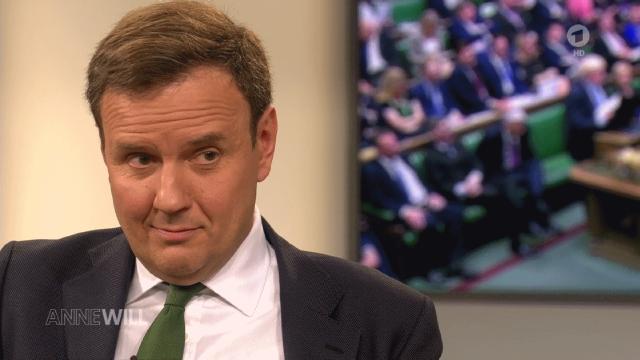
You almost have to feel sorry for Greg Hands, sitting as a guest on Anne Will’s show, trying to defend Tory policy. Invited to a five-to-one Brexit bashing, it’s a debate of the ilk where the quacks aren’t invited in the name of ‘balance’. From the off, and as if to distance himself from the madness he’s supporting, Hands immediately claims to have been anti-Brexit, to have been anti-Boris during the leadership change. But not one to let principles get in the way, he’s supporting both of them because ‘democracy’. What follows is a virtuoso display of logical acrobatics skills as he attempts to defend his position: the shittiness of Britain’s democracy (being old is apparently a compliment?); that the referendum somehow showed clarity of purpose; that Boris threatening to ignore the law to push through a no-deal Brexit is democracy in action; that proroguing parliament is standard procedure and clearly shouldn’t be reconsidered at such a crucial juncture; that an election could show what the people want, but a second referendum would be undemocratic. If he weren’t sitting there looking like a naughty schoolboy called to the headmaster’s office, his mind-bending mental tricks might have earned some applause.
3 minutes to read

6 Ways of Breaking the Brexit Deadlock

6 Ways of Breaking the Brexit Deadlock

If at first you don’t succeed, you fail.

GLaDOS, Portal

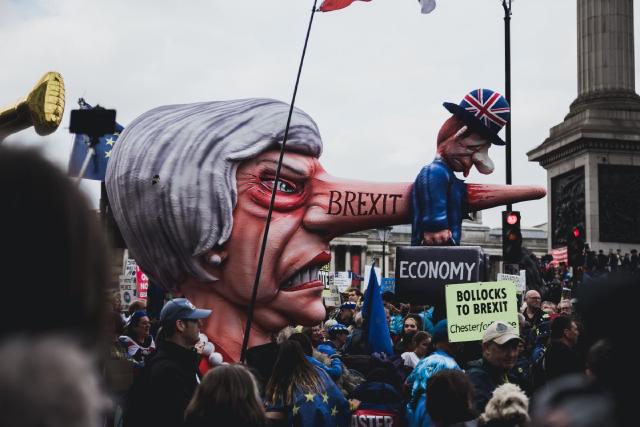
Ardent Remexiteer Theresa May managed to spend the latter half of her illustrious spell as prime minister trying to ram her deal through the Commons like a skipping needle on a strong and stable turntable. Now she’s abandoning ship, the sycophants and navel-gazers are lining up around the block to be the next hero to try to pull the sword from the stone. Unfortunately, with yon parliament rejecting the deal, and selfsame parliament rejecting no deal, the likelihood of the next helmsman managing to successfully navigate this particular brown waterway looks slim. And with the public still split down the middle , even a new referendum would probably only turn back the clock as far as 23rd June 2016.

5 minutes to read
Brexit Bullshit

Brexit Bullshit

Back in the UK for a while watching the Brexit bullshit slowly roll from one stagnant puddle to the next, occasionally spattered by the shrill wailing tweetarrhia from Trump’s cot, it’s sometimes tempting to imagine we are really all lying inert, plugged into machines while hackers play pong on the Matrix. Is there an infectious disease going around causing collective cerebral atrophy? Maybe a race of bodysnatchers seeding the populace with cretins wondering how long it will take us to twig? Or are we just watching the unfolding of H. L. Mencken’s prophecy and the glorious consummation of democracy and technology?
7 minutes to read

The Problem of Europe

President Sarkozy will not be the one to tell French schoolchildren that the borders of Europe extend to Syria and Iraq , ((Earlier report on Sarkozy’s election here [in German].)) should Turkish overtures to the EU be fully accepted. One must assume then, that he would have no problem explaining that the current borders of the EU extend to Morocco on mainland Africa , or that France itself shares borders with Brazil and Suriname. Or perhaps that under fifty years ago, its borders extended south to the Sahara Desert .
One minute to read

Biofuels: Oil for Votes?

Where your next tankload is coming from?

Just where is the EU going with its agricultural policy? With the European Commission endorsing a plan to up the previous goal of a 5.75% market share for biofuels in the overall transport fuel supply by 2012, to 10% by 2020, one has to wonder which part of the EU’s goals is being pushed hardest. From the EU website :

4 minutes to read

Failte go dti an tAontas Eorpach

The EU

On January 1st of this year, under the continuing enlargement plans, Romania and Bulgaria acceded to the European Union. At the same time, the number of official EU languages was enlarged to 23, now including Romanian, Bulgarian - and Irish. The inclusion of the latter might seem to come at an odd time, given that the Republic of Ireland has been a member since January 1st, 1973, and Irish is its official language. Yet it was through English that the Republic handled its application to the Union.

To take some basic figures, Irish is spoken by less than half of the Republic’s population, whilst it is in daily use by only 5% ((A generous assessment, since this figure appears to include schoolchildren who use the language in class on a daily basis.)). To put this in some perspective, there may be more than twice as many Welsh speakers, while both of these Celtic tongues pale in comparison to Catalan, for example, with more than 7 million speakers. Ireland’s European commissioner, Charlie McCreevy, insists that Irish is central to Irish cultural identity, and its acceptance into the European fold has prompted calls for the inclusion of other minority languages ((Spain has already requested semi-official status for Catalan, Galician and Basque.)).

6 minutes to read

Ireland Avoids the Burdens of Public Transport

This weekend a radio talk show in Ireland was lamenting the state of the Irish road network, in particular focusing on the state of her road signs. Anyone that has driven through the country will understand how this seemingly trivial matter could be focus for an entire discussion. The cause of the problem was perceived to be the decentralised system of transport regulation, the result being a wide disparity between different parts of the country, and a generally poor system compared to European standards. The show received numerous SMS messages and emails highlighting more extreme examples, from road signs incorrectly directing traffic, through long stretches of road with nary a road-sign or indication of turnings, to the example of sections of road with conflicting speed limits, no doubt compounded by some complications in the changeover from miles to kilometres per hour.

Yet what was only mentioned in passing was that government initiatives to improve the transport network in the country can only be spent once, and ultimately further improvements to the road network must necessarily mean public transport receives less funding. One of the interesting statistics cited was that in Dublin, the only large urban centre, around 70% of commuters travel to work by private transport. Although unduly unfair, for the sake of comparison just consider the figures for the centre of London, which show the figure to be as low as 10%. Is Ireland’s public transport system underperforming?

8 minutes to read

Travels in the Shadow of the Curtain

Despite it feeling like almost yesterday, a fortnight has already passed since I returned from this year’s travels. With the jet-set revolution in full swing, and RyanAir’s European footprint under continuous eastward expansion, I took the opportunity this year to expand my own carbon footprint and head to the east. Armed with a smattering of Russian, an able German companion and a small roll of banknotes, this year’s travels took me to Riga, third largest industrial city of Imperial Russia, and capital of one of the more vibrant economies in Europe today. After five days in a bed & breakfast there, it was followed by a stay in probably the most famous cultural and historical city in Poland: Krakow.
6 minutes to read